So today I was in the middle of vacuuming my floors and had to do something with the baby so I just dropped the vacuum on the floor... thinking I would get to it later.. no big deal, right? Anyway, so I made lunch for the kids, put everything on the table, and called everyone to eat.
Simple, right?
Wrong.
"Um.. mom, I can't get to the table"
I look down and my daughter (who is knee walking) is looking up at me after trying to figure out how to go around the vacuum cleaner on the floor. I apologized profusely and quickly moved the vacuum to a more unobtrusive location.
Things like this happen sometimes but I'm usually very good about keeping things off the floor - organizing shoes so they aren't in the hallways - you know - normal household cleaning stuff. The only difference in my house, though, is that if I don't clean up or tidy messes all day long, my daughter suffers and isn't able to access parts of her own home.
That reminds me of why we bought the house we did.. we just moved a year ago but it was a while looking before we actually found something appropriate. We looked at tons of beautiful houses in beautiful neighbourhoods - some of which we would've otherwise purchased - except that we were looking for a barrier free property that allowed easy access throughout the home (in our case wheelchair access).
Here is what wikipedia tells us about barrier-free http://en.wikipedia.org/wiki/Barrier-free
Think about every house you've lived in and tell me if you think it's barrier free.. or even CLOSE to being barrier free. How wide were the doorways? 30 inches? Let's see (calculating standard width of a wheelchair = 25-27 inches plus oh let's say 3 inches per hand if you're holding ONTO the wheels to move it = 6 inches) so if 30 inches is a standard door width and a person in a wheelchair needs 31-33 inches - looks like they're not getting through there doesn't it? Also - look down at the thresholds of your doorways or where different flooring types meet. Is there a big bump/step up/threshold piece? Hmm.. another FAIL. Take note of the bottom of rounded stairs, do they jut out into the hallway? Is the hallway wide enough? Do you have major sets of stairs to even enter the home? Is there a main floor washroom? Bedroom? Things I never even would've considered as factors in buying a home before are now front and center.
Anyway - that's it for me today - peace love.
Sunday, October 17, 2010


Wednesday, October 6, 2010
How do you teach your child to talk?
So - growing up, I never heard anything about teaching your children how to talk.. it seemed like it "just happened" for normal folk.. I suppose it's something similar to how kids learn to sit, crawl and walk - it "just happens" ... or does it?
Honestly, we were never really concerned about T's progression with speech.. I'd been advised early on to not worry about milestones.. it was great advice too.. if you sit and worry that your child isn't meeting each milestone, you will be disappointed and be depressed - guaranteed. I'm not saying not to be concerned and definitely seek medical advice if your child isn't "keeping up" but if you have your diagnosis and you know to expect delays then expect delays and roll with it. So anyway, T was seeing a speech language pathologist as part of her therapy team at the treatment centre. It was one of her favorite appointments as the therapist would play games with her, show her pictures, try to get her to model sounds and words.. it was great fun for her which is key when you want her to participate and see results.
Our therapist suggested that we get on the waiting list for the Hanen course (I mentioned this earlier) called "It Takes Two to Talk" http://www.hanen.org/web/Home/HanenPrograms/ItTakesTwoToTalk/tabid/76/Default.aspx Both my husband and I attended class every week for 2 hours and we had homework to do. The idea is that the family/home situation is the best place to teach communication and reinforce good speech patterns, etc. We started the course with a visit from one of the instructors where they videotaped us interacting with our daughter. They then played the tape back and analyzed our interactions - giving us pointers on how we could improve communication. We did a few of these sessions throughout the course and we would also view the video clips in class along with the other parents and we could provide suggestions/encouragement/comments on the other videos as well.
One thing I remember the most was that we had two parents in our class of a little boy who had Down's Syndrome. They were not shy by any means but they were definitely concerned for their son and his language. They were concerned that he wasn't meeting the language milestones with the appropriate number of words for his age. As we watched their video - we were all amazed. Yes he didn't have much of a verbal vocabulary but he was signing NON STOP. I swear, this kid had at least 100 words in sign language - probably more at the time than any of the other children. They were shocked when discussion time came for their video when we (including the instructors) were congratulating them on the fabulous communication they had with their son.. he was able to communicate with them, no one was frustrated, the messages were clear. One thing I loved about this course is that they support and encourage alternate forms of communication - sign language is just as valuable as verbal and can even be used in combination with verbal language.
To this day if T thinks I haven't heard what she said or I'm not paying attention, she will say the word AND do the sign just to make sure I understand her. I think EVERY parent should teach their child sign language from an early age - you will be amazed at how much they can communicate with you early on and how less frustrated they will be knowing that they can communicate with you. I was SO thrilled the other day when my youngest (11 months) signed "more" to me at the breakfast table.. awesome buddy.
It looks like they have this program all around the world
http://www.hanen.org/web/Home/SpeechLanguagePathologistsTherapists/FindaHanenSLPT/tabid/62/Default.aspx
I would HIGHLY recommend finding a location near you and enrolling in the course - you and your child will benefit from it!
Oh - in case you are a results based kind of person.. we're about 2 years after taking the course and working with our daughter and she is age appropriate with her speech now and no issues now at all.. In fact, I think she's pretty grown-up with her speech and very creative too .. telling me she couldn't "finish her orange juice because it lowers my IQ" .. nice try kiddo.
Friday, October 1, 2010
Missing out on a "normal" childhood
Here is a little article that I've read a bunch of times over the past few years.. just re-read it this morning. It's meant to help others understand what it's like raising a child with a disability.
http://www.our-kids.org/Archives/Holland.html
http://www.our-kids.org/Archives/Holland.html
Wednesday, September 29, 2010
Funding Resources
One of the first things our social worker mentioned to us was sources of funding.. Funding for what?
There are many other sources of funding - one that we use very often is the Ontario Assistive Devices Program or ADP http://www.health.gov.on.ca/english/public/program/adp/adp_mn.html. They will pay a portion of the device (orthotics, prosthetics, walking aids, wheelchairs, etc.) You would then submit the remainder of the cost to your insurance company (if you were lucky enough to have that through your work or otherwise) or pay out of pocket.
Honestly, we were so embarrassed asking anyone for anything that we didn't fill out the forms.. our social worker filled it out for us. The first thing was Special Services at Home (SSAH) http://www.children.gov.on.ca/htdocs/English/topics/specialneeds/specialservices/index.aspx from the Ministry of Community and Social Services. This is flexible funding that can be used for a variety of things such as hiring a care worker to help you in the house or just respite services (meaning just give the family a BREAK)
I told the social worker - we make okay money.. we don't *need* to get funding.. she stopped me there. She said, you have no idea how much more money you will spend on your child than the average parent. Think about all the additional expenses you will have in terms of equipment, daily living aids, specialized clothing, activities requiring you to hire a personal teacher or helper (i.e. her own gymnastics teacher instead of being in a group class)
I typically HATE using statistics if I don't know where the sources are from and what the methodology is BUT the Canadian Council on Social Development tells me that it costs an average of $166, 549 to raise a girl to age 18 ($166,972 for boys who eat more) http://www.ccsd.ca/factsheets/family/ So that is roughly $9200 a year to raise my girl (yes, I'm rounding down - just go with me)
In contrast, the added cost (above and beyond the average) to raise a disabled child in Canada can be upwards of $8000 a year. http://www.ncbi.nlm.nih.gov/pmc/articles/PMC1802121/. So that would put the grand total up to $310,549 for 18 years. I've read other articles that estimate the cost to be 3-4 times average, so that would be in the $500,000 - $660,000 range!
I certainly don't have that kind of dough lying around in my back pocket...
Okay - so I can't help but plug my organization but Statistics Canada has a publication and data tables from 2001 on Children with disabilities and their families http://www.statcan.gc.ca/pub/89-586-x/index-eng.htm. Let's talk about the opportunity cost of caring for a child with a disability. Statcan mentions a few reasons why the child may have an economic impact on a family - things like; parent working fewer hours, changing their work hours, not taken a job in order to care for the child, quit working, and turned down a promotion or a better job. In some cases, the parents need to devote their entire lives all day every day to caring for their children - how are they making ends meet?
So how does the Canadian government help? Well there is:
- Disability Tax Credit for which you must fill out the Disability Tax Credit Certificate http://www.cra-arc.gc.ca/E/pbg/tf/t2201/README.html. Do this as SOON as you get your diagnosis as it's a pre-requisite for a lot of other services. The credit on the tax return is a huge benefit - very worth while.
- Medical tax credits. http://www.cra-arc.gc.ca/E/pub/tg/rc4064/rc4064-e.html#P193_7724 You can deduct medical expenses (up to $10,000 per dependent) and can even claim moving expenses if you are moving to a more accessible home.
- Child Disability Benefit (CDB) http://www.cra-arc.gc.ca/bnfts/dsblty-eng.html is a tax-free monthly payment per child (up to $205.83 per month depending on family net income) Once you send in the tax certificate mentioned above, this will be sent to you automatically. As an aside (and kudos to my government - thanks guys) I didn't send in my daughter's form until she was 2 and they sent me a cheque for all the money I would have received since she was born. That rocked.. thanks Canada.
- Registered Disability Savings Plan (RDSP) http://www.cra-arc.gc.ca/tx/ndvdls/tpcs/rdsp-reei/menu-eng.html is
- Canada Disability Savings Grant is new program where the government will match your investment into the RSDP as follows: The amount of the CDSG is based on the beneficiary’s family income as follows:
Beneficiary's
family incomeContribution Grant Maximum $77,664*
or lessOn the first $500 $3 for every $1 contributed $1,500 On the next $1,000 $2 for every $1 contributed $2,000 More than
$77,664*On the first $1,000 $1 for every $1 contributed $1,000 - Canada Disability Savings Bond is where the government will contribute to the individual's RDSP if their family income is less than $21,816
There are many other sources of funding - one that we use very often is the Ontario Assistive Devices Program or ADP http://www.health.gov.on.ca/english/public/program/adp/adp_mn.html. They will pay a portion of the device (orthotics, prosthetics, walking aids, wheelchairs, etc.) You would then submit the remainder of the cost to your insurance company (if you were lucky enough to have that through your work or otherwise) or pay out of pocket.
Early Childhood Intervention
The one consistent message I've encountered over the past four years is: start therapy as early as possible. I suppose this is even more key when dealing with a brain injury as the brain is more elastic when we are young. Although it is not possible to "cure" cerebral palsy, (and by the way, it drives me nuts when people say that) the brain can "repair" itself and make new neural pathways/connections. So for my daughter, other white brain matter can take over for the missing white matter in order to move/function the affected areas.
One of the ways this happens is repetition... you train your brain by doing an activity to teach it how it's done. I often liken this to someone who's had a stroke, only they are re-learning what they already knew. In T's case, she had to learn everything from scratch.
This brings me to one of the things that makes me sad/angry about the whole situation. For every milestone that we reached like rolling, sitting or crawling (which isn't an actual milestone), she had to work probably 4-10 times harder than a "normal" child. Don't even get me started on the walking thing - she's not walking yet but we're working hard on it.
<offside rant coming>
I just remembered an advertisement for the "Weekend to end Breast Cancer" that I saw at work in 2009.. here is a copy http://mo09.endcancer.ca/site/DocServer/9043_FundraisingFlyer_MO_ENG.pdf?docID=8842 (it wasn't this exact one) I was shocked and appalled at what I read "BREAST CANCER IS HARD. WALKING IS NOT". Really? Really? Okay, so I am definitely a breast cancer research supporter especially having it in my family but I really question who in the world came up with this one.. I even wrote a formal letter to complain and got no response.. nice. Well anyway.. breast cancer is hard and walking is sometimes hard too, just FYI. :P
<rant complete>
Where was I? Oh yes.. intervention. Like I said, we were referred to the Ottawa Children's Treatment Centre and assigned a physiotherapist, occupational therapist, speech therapist and a social worker to manage everything. Although I was hesitant, at first, to see the social worker - we were lucky enough to see someone who was just about to retire BUT knew all the ins and outs of the system and funding options, etc. (I'll do a separate post on funding and resources)
At first she HATED going to therapy and pretty much cried every time.. we had 1 hour appointments bi-weekly with each therapist so it was pretty darn taxing on us (keep in mind we both had/have full time jobs so we would need to take time off work, go to the appointment and then drop her off at daycare before returning to work) I'll probably do another post on work/life balance too as I'm sure that's killer for most folks (even without the extra challenges we face)
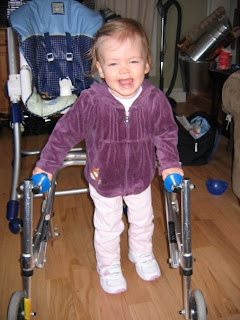 Physiotherapy in the early years was a lot of stretching, positioning and teaching how to roll and sit. One of THE best products I found to help your child sit (disability or no) was a boppy pillow.. not just ANY boppy pillow and certainly not a nursing pillow which encourages your child to lean and slouch against it.. it is fairly low and has an attached piece of fabric to prevent slipping. I'll post a picture when I can. Physio was the worst as it was scary and uncomfortable for her.. she would scream and look at me like "why are you doing this to me mom?" It was awful.
Occupational therapy was always great fun.. in physio they work on the gross motor functions (read big movements) and in occupational therapy they work a lot on fine motor skills (detailed work using hands/fingers, etc.) I remember when I was younger hearing about occupational therapy thinking that people went to see shrinks because they didn't like their jobs (hee hee) ;) Occupational therapy basically helps individuals with "age appropriate" activities - so in a child, it would be learning how to play and manipulate their environment.. later it would be dressing themselves, etc. She always loved going to OT unless a therapy ball was involved.. she still gets scared when she's off balance because she feels really out of control.
We also went to a speech therapist who referred us to take a course for parents called Hanen http://www.hanen.org/web/Home/tabid/36/Default.aspx. I think this course should be mandatory for ALL parents as it teaches you how to communicate with your child and to encourage them to communicate with you. It was awesome and T's speech just exploded after that. I might do a separate post on Hanen because I have so many positive things to say about it.
Anyway, so T went to therapy bi-weekly with each therapist since she was 1 year old (she's now 4) so that's a LOT of sessions. Each therapist would give us things to work on at home, goals to accomplish and report back on next time. After hearing about some of the other options available, I'm SO thankful we went this route and were so directly involved from the beginning. You really need to be involved in this process with your child. Please don't outsource it as much as you can help it.. but if you can't, keep sticking your nose in and make sure your child is getting the best care possible.
One of the ways this happens is repetition... you train your brain by doing an activity to teach it how it's done. I often liken this to someone who's had a stroke, only they are re-learning what they already knew. In T's case, she had to learn everything from scratch.
This brings me to one of the things that makes me sad/angry about the whole situation. For every milestone that we reached like rolling, sitting or crawling (which isn't an actual milestone), she had to work probably 4-10 times harder than a "normal" child. Don't even get me started on the walking thing - she's not walking yet but we're working hard on it.
<offside rant coming>
I just remembered an advertisement for the "Weekend to end Breast Cancer" that I saw at work in 2009.. here is a copy http://mo09.endcancer.ca/site/DocServer/9043_FundraisingFlyer_MO_ENG.pdf?docID=8842 (it wasn't this exact one) I was shocked and appalled at what I read "BREAST CANCER IS HARD. WALKING IS NOT". Really? Really? Okay, so I am definitely a breast cancer research supporter especially having it in my family but I really question who in the world came up with this one.. I even wrote a formal letter to complain and got no response.. nice. Well anyway.. breast cancer is hard and walking is sometimes hard too, just FYI. :P
<rant complete>
Where was I? Oh yes.. intervention. Like I said, we were referred to the Ottawa Children's Treatment Centre and assigned a physiotherapist, occupational therapist, speech therapist and a social worker to manage everything. Although I was hesitant, at first, to see the social worker - we were lucky enough to see someone who was just about to retire BUT knew all the ins and outs of the system and funding options, etc. (I'll do a separate post on funding and resources)
At first she HATED going to therapy and pretty much cried every time.. we had 1 hour appointments bi-weekly with each therapist so it was pretty darn taxing on us (keep in mind we both had/have full time jobs so we would need to take time off work, go to the appointment and then drop her off at daycare before returning to work) I'll probably do another post on work/life balance too as I'm sure that's killer for most folks (even without the extra challenges we face)

Occupational therapy was always great fun.. in physio they work on the gross motor functions (read big movements) and in occupational therapy they work a lot on fine motor skills (detailed work using hands/fingers, etc.) I remember when I was younger hearing about occupational therapy thinking that people went to see shrinks because they didn't like their jobs (hee hee) ;) Occupational therapy basically helps individuals with "age appropriate" activities - so in a child, it would be learning how to play and manipulate their environment.. later it would be dressing themselves, etc. She always loved going to OT unless a therapy ball was involved.. she still gets scared when she's off balance because she feels really out of control.
We also went to a speech therapist who referred us to take a course for parents called Hanen http://www.hanen.org/web/Home/tabid/36/Default.aspx. I think this course should be mandatory for ALL parents as it teaches you how to communicate with your child and to encourage them to communicate with you. It was awesome and T's speech just exploded after that. I might do a separate post on Hanen because I have so many positive things to say about it.
Anyway, so T went to therapy bi-weekly with each therapist since she was 1 year old (she's now 4) so that's a LOT of sessions. Each therapist would give us things to work on at home, goals to accomplish and report back on next time. After hearing about some of the other options available, I'm SO thankful we went this route and were so directly involved from the beginning. You really need to be involved in this process with your child. Please don't outsource it as much as you can help it.. but if you can't, keep sticking your nose in and make sure your child is getting the best care possible.
Sunday, September 26, 2010
The Diagnosis
So here is the single most important thing I'll tell you in this blog.. if you take nothing else from this, take my advice to make sure you get an ACCURATE and DEFINITIVE diagnosis for your child's "condition" IN WRITING!
I can't tell you how often we've needed a physician's letter or proof of diagnosis to even apply for services. I know of other families who have had situations where the condition has not been discovered/defined and that children are WAITING for services because no one knows where they "fit".
Also know that even if you have a diagnosis - it can be changed later to be more accurate if you discover more as the child gets older. Just get something written down so you can benefit from early childhood intervention.
Okay so - at around 6 months of age, I took T to neurology at the children's hospital and she had a clinical examination.. I told the doctor of her symptoms stating that I didn't think she had any symptoms relating to hydrocephalus but had almost ALL the symptoms relating to cerebral palsy (thumb in palm, scissoring legs, etc.). He took one look at her and looked at me and said outright "yes, I believe she has cerebral palsy". How refreshing! I think he realized that I'd done all my research and wasn't afraid to hear the truth. It makes me wonder if other doctors sugar coat things or are wishy-washy so as to cover their butt in case they're wrong...
Anyway, we ended up doing the MRI to find the source and extent of the brain damage. When the neurologist presented the results, he said "good news - her ventricles aren't getting bigger, bad news - she's missing parts of her brain" Sounds funny - but honestly it was a relief to know that we weren't in store for years of brain surgery and shunts.. but missing parts of her brain? Seriously? Seriously.
 We stared at the MRI and, sure enough, gray matter - check.. white matter - hmmm, some missing. Layman's explanation of brain matter: gray matter is where you do your thinking, white matter is what transfers your thoughts into actions (sending impulses to your muscles) For whatever reason, (we still don't know) my child's white matter did not develop in utero which will make it hard for her to control some muscles in her body. This explains why you see people with CP have jerky motions with their affected limbs.. think of it like a short in an electrical wire.. it works a little, then not, then works again.
SO - we had our diagnosis (in writing) and our neurologist (we love you Dr. Doja) referred us to the Ottawa Children's Treatment Centre where (after a few months waiting) we were able to start our early intervention program!
I can't tell you how often we've needed a physician's letter or proof of diagnosis to even apply for services. I know of other families who have had situations where the condition has not been discovered/defined and that children are WAITING for services because no one knows where they "fit".
Also know that even if you have a diagnosis - it can be changed later to be more accurate if you discover more as the child gets older. Just get something written down so you can benefit from early childhood intervention.
Okay so - at around 6 months of age, I took T to neurology at the children's hospital and she had a clinical examination.. I told the doctor of her symptoms stating that I didn't think she had any symptoms relating to hydrocephalus but had almost ALL the symptoms relating to cerebral palsy (thumb in palm, scissoring legs, etc.). He took one look at her and looked at me and said outright "yes, I believe she has cerebral palsy". How refreshing! I think he realized that I'd done all my research and wasn't afraid to hear the truth. It makes me wonder if other doctors sugar coat things or are wishy-washy so as to cover their butt in case they're wrong...
Anyway, we ended up doing the MRI to find the source and extent of the brain damage. When the neurologist presented the results, he said "good news - her ventricles aren't getting bigger, bad news - she's missing parts of her brain" Sounds funny - but honestly it was a relief to know that we weren't in store for years of brain surgery and shunts.. but missing parts of her brain? Seriously? Seriously.

SO - we had our diagnosis (in writing) and our neurologist (we love you Dr. Doja) referred us to the Ottawa Children's Treatment Centre where (after a few months waiting) we were able to start our early intervention program!
Subscribe to:
Posts (Atom)